 Codon Craft

Build machines that read DNA.
A programming puzzle without code. Lay tracks, readers and writers on a grid, then watch your machine sort, repair and rewrite DNA.

iPhone version coming soon
Free to start. One purchase unlocks the rest. No ads, ever.
Strands go in. Your machine decides.
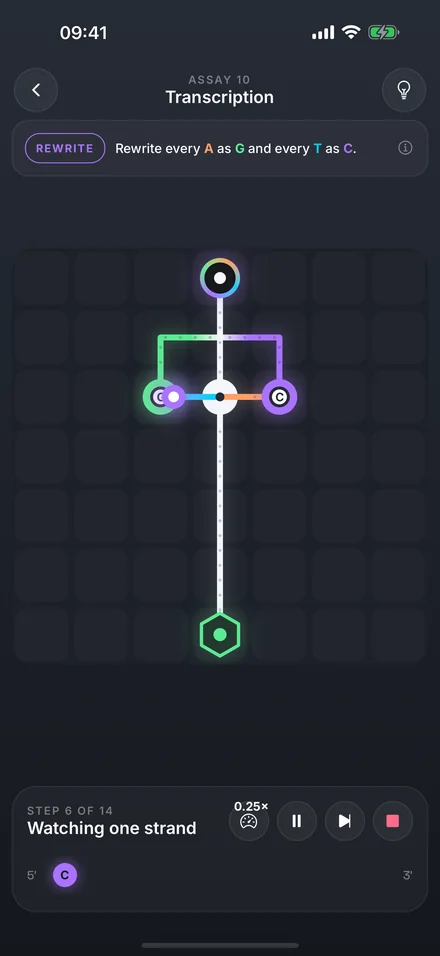
This one accepts strands that end in T. Each reader snips the first base off a strand and sends it down the arm of that colour.

When a strand runs out, the top reader recycles it and the bottom one files it in the Vault. Pick one and press Run.
That is one small machine. The game asks for far bigger ones.
iPhone version coming soon
Simple parts. Turing complete.
You get a grid and three kinds of part. Put enough of them together and they can compute anything a computer can.
Each new part arrives with a short lesson from the curator. Then the puzzles start asking for loops, counters and memory that you build yourself.
Every part is real cell machinery, and the journal explains the biology as you go. The classic Manufactoria puzzles are all here, rebuilt for touch, alongside new ones of our own.
Tracks
Motor proteins carry each strand the way the track points. Draw a path with your finger and they follow it.
In a cell: microtubules, walked by kinesin motor proteins.
Readers
Snip the first base off a strand and send it down the arm of that colour. Nothing to snip? Out the white arm it goes.
In a cell: exonuclease enzymes, which chew bases off one end.
Writers
Add one base to the end of a strand. Use C and G as bookmarks, counters and memory.
In a cell: DNA polymerase, which builds strands at their 3′ end.
When it breaks, watch it break.
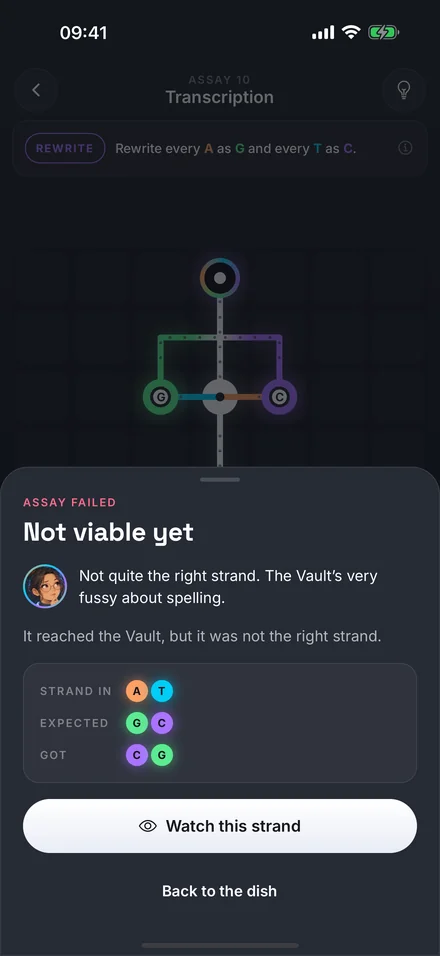
A failed run shows you the exact strand that beat your machine. Replay it tile by tile, slow it down, and see where it went wrong.
Hints, one at a time
Stuck? Dr Franklin’s notes reveal one hint at a time, so you only take what you need. Hints are always free.
Then make it smaller
Every solution counts its parts and steps. Come back later and build it smaller, or faster.
Save the last library of life.
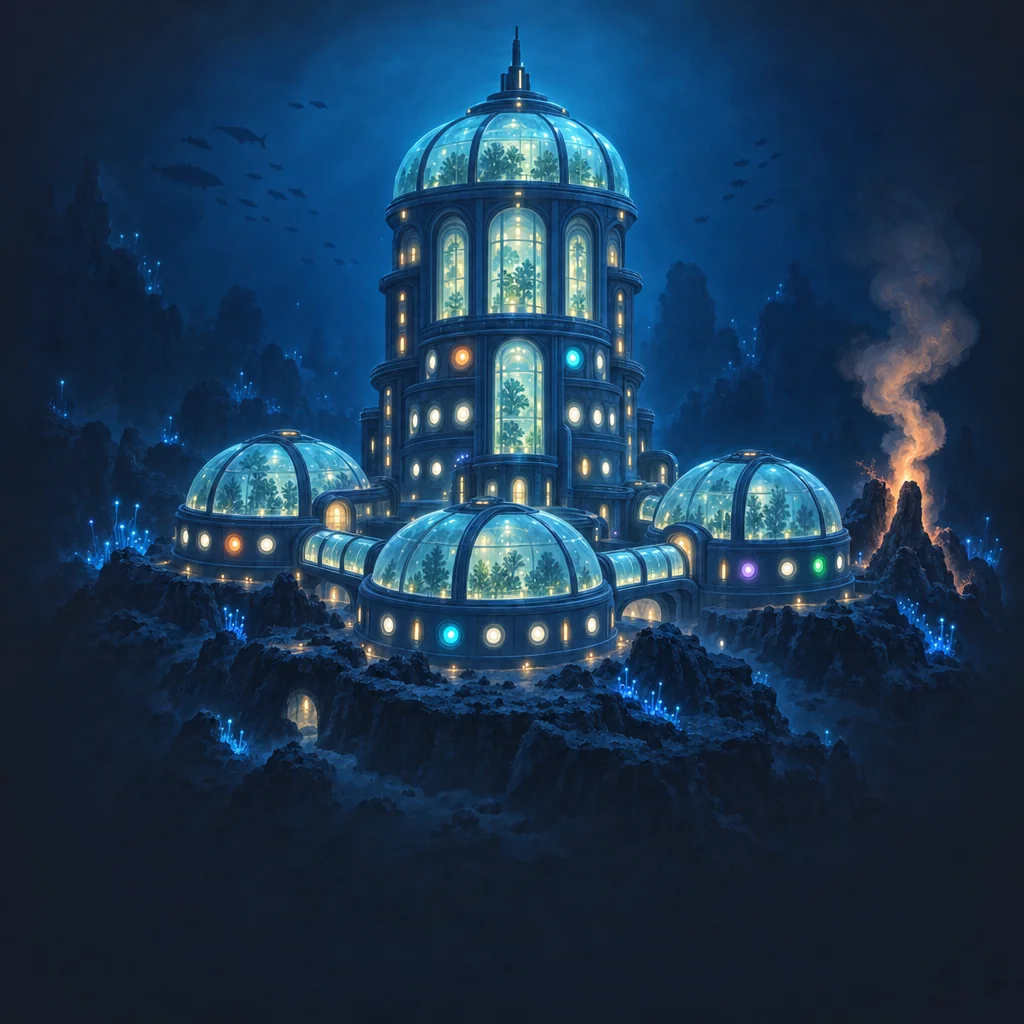
Four kilometres below the Pacific, warmed by a hydrothermal vent, sits the last library of life on Earth. Every species we managed to save is kept here, written as DNA. No pressure. Well, about four hundred atmospheres of it, but none of it on you.
 Dr Ada FranklinCurator of the Lumen Archive
Her last apprentice left a lot of unfinished work behind, and a great many sticky notes. Every machine you build keeps the Archive alive, and her story moves on with it.
Free to start. Pay once if you love it.
- The first puzzles are free, hints and all.
- One purchase, the Full Archive, unlocks everything after them, for good.
- No ads, subscriptions, energy or timers. Just puzzles.
Questions
Do I need to know how to code?
No. If you can follow a train track, you can build a machine. Each part comes with a short lesson and the puzzles grow from there. Programmers will spot loops and state machines, but you never type a line of code.
What does the Full Archive cost?
US$4.99 once, or the same in your own currency. Your store shows the exact price before you pay, and there is nothing else to buy, ever.
Is this Manufactoria?
It grew from it. The mechanics and classic puzzles follow Nicholas Feinberg’s Manufactoria, rebuilt for touch with a story, new art and new puzzles of our own.
Can I move my progress to another phone?
Yes. Settings has a save code that carries your solved puzzles to another device. Your purchase is restored through your store account.
Which phones does it run on?
Android phones today. The iPhone version is with Apple for review and will follow soon.

The Archive is waiting, apprentice.
Your first machine takes about a minute. The last ones might take a weekend.
iPhone version coming soon
Free to start. One purchase unlocks the rest. No ads, ever.